Vault Network
Private Market Social

Designing the professional layer for private market investors and high-growth companies — from zero to a full-featured social product.

Client

Vault Network

My Role

Lead UX/UI Designer

Timeline

2025-2026

Deliverables

Landing Page · Social Product · Design System
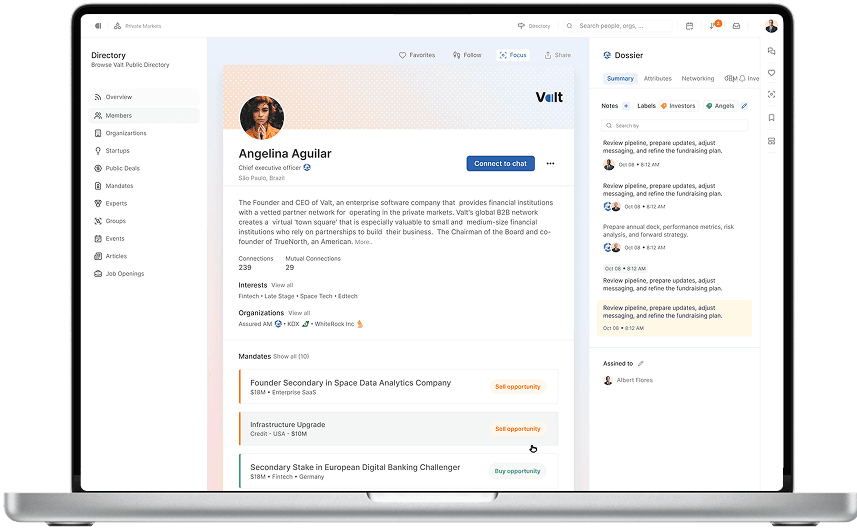
The project at a glance

Context

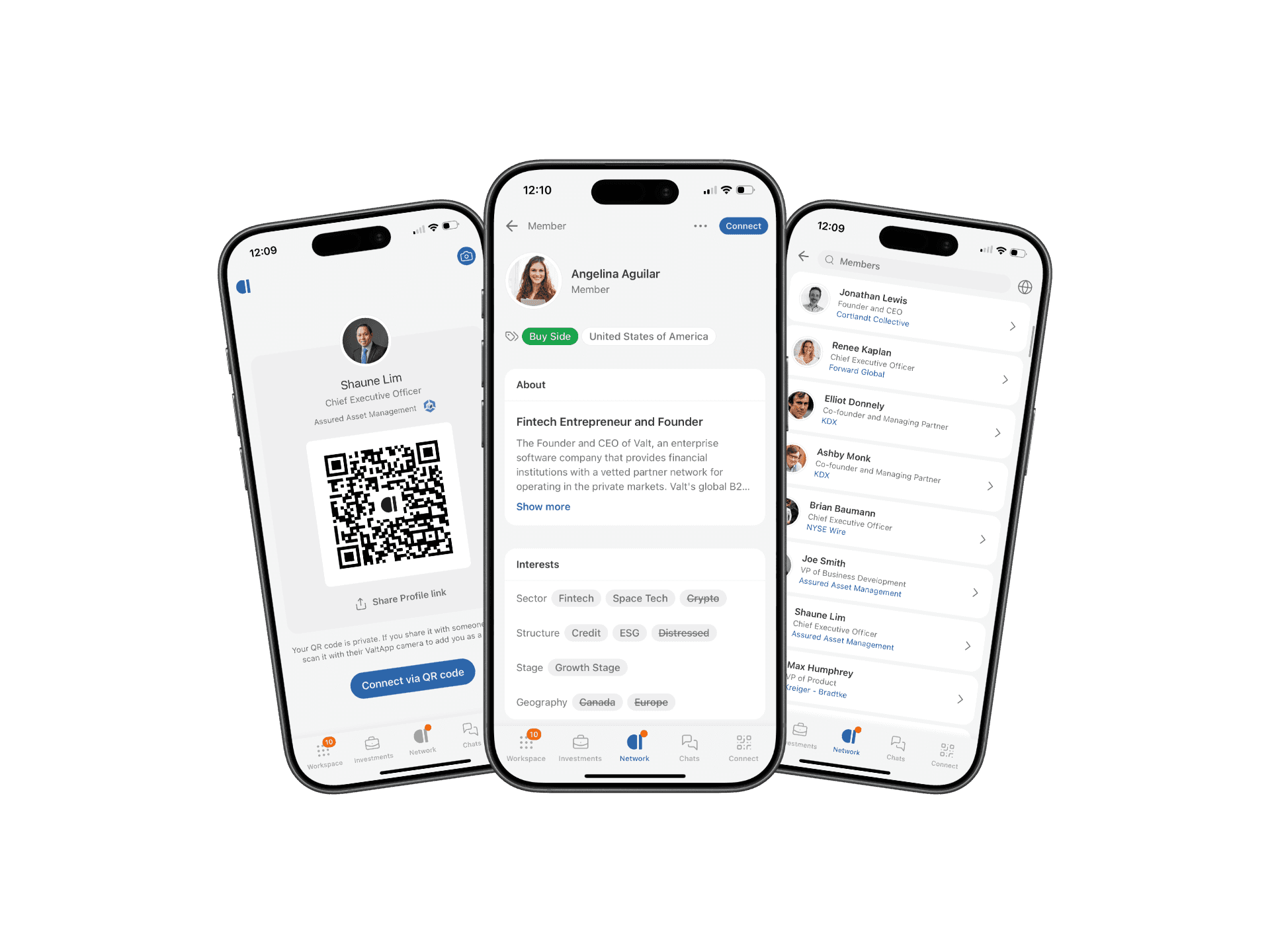
Vault Network is a private market social network connecting investors — LPs, GPs, Angels, Family Offices — with high-growth private companies actively seeking capital. The platform was designed to replace fragmented, informal relationship-building in the private market with a structured, verified, and intelligence-driven environment.

My Contribution

I owned the end-to-end UX and UI of both the landing page and the social product experience. Starting from concept definition, I led user flows, information architecture, wireframing, high-fidelity design, and the design system that supports the product.
USER RESEARCH

Wireframing

Design System

Information Architecture

UI Design

Prototyping

Private markets were built on
information gaps

Before Vault, serious investors and growth-stage companies had no structured, verified place to find each other. The status quo was broken — and that was the opportunity.

Problem 01

No verified identity layer. Existing platforms mixed professionals with noise — unverified profiles, anonymous actors, and irrelevant connections diluted signal for serious investors.

Problem 02

Founders cold-emailing into the void. Private companies had no structured channel to surface to thesis-aligned investors — and no way to control what information was shared or with whom.

Problem 03

Zero deal flow intelligence. Investors had to rely on personal networks and luck to discover opportunities early. There was no platform providing structured signals for private market deal flow.

Private markets
were built on
information gaps

Private markets were built on information gaps

Before Vault, serious investors and growth-stage companies had no structured, verified place to find each other. The status quo was broken — and that was the opportunity.

Problem 01

No verified identity layer. Existing platforms mixed professionals with noise — unverified profiles, anonymous actors, and irrelevant connections diluted signal for serious investors.

Problem 02

Founders cold-emailing into the void. Private companies had no structured channel to surface to thesis-aligned investors — and no way to control what information was shared or with whom.

Problem 03

Zero deal flow intelligence. Investors had to rely on personal networks and luck to discover opportunities early. There was no platform providing structured signals for private market deal flow.

Process

How I
approached it

A structured design process from discovery to delivery — anchored in user needs and business constraints.

01

Discovery

Understanding the Private Market

Stakeholder interviews with investors and founders to map existing workflows, pain points, and mental models around deal flow. Competitive analysis of existing platforms (LinkedIn, AngelList, Carta) to identify the whitespace.

Research Synthesis

User Personas

Competitive Audit

02

Define

Information Architecture & User Flows

Mapped the core journeys for both user types — investor and company — across discovery, verification, connection, and deal flow. Defined the IA for the social product and the landing page conversion funnel.

User Flows

information Architecture

Jobs-to-be-Done

03

Design

Wireframes & High-Fidelity UI

From low-fidelity wireframes to high-fidelity screens — iterated rapidly based on internal reviews. Built the design system (components, tokens, patterns) in parallel to ensure consistency across the product and landing page.

Wireframes

Design System

Hi-Fi Screens

Component Library

04

Deliver

Prototyping & Handoff

Interactive prototype for key user flows — verification, profile setup, deal discovery, and connection. Structured handoff documentation for the development team including specs, tokens, and interaction notes.

Interactive Prototype

Dev Handoff

Documentation

Process

How I
approached it

A structured design process from discovery to delivery — anchored in user needs and business constraints.

01

Discovery

Understanding the Private Market

Stakeholder interviews with investors and founders to map existing workflows, pain points, and mental models around deal flow. Competitive analysis of existing platforms (LinkedIn, AngelList, Carta) to identify the whitespace.

Research Synthesis

User Personas

Competitive Audit

02

Define

Information Architecture & User Flows

Mapped the core journeys for both user types — investor and company — across discovery, verification, connection, and deal flow. Defined the IA for the social product and the landing page conversion funnel.

User Flows

information Architecture

Jobs-to-be-Done

03

Design

Wireframes & High-Fidelity UI

From low-fidelity wireframes to high-fidelity screens — iterated rapidly based on internal reviews. Built the design system (components, tokens, patterns) in parallel to ensure consistency across the product and landing page.

Wireframes

Design System

Hi-Fi Screens

Component Library

04

Deliver

Prototyping & Handoff

Interactive prototype for key user flows — verification, profile setup, deal discovery, and connection. Structured handoff documentation for the development team including specs, tokens, and interaction notes.

Interactive Prototype

Dev Handoff

Documentation

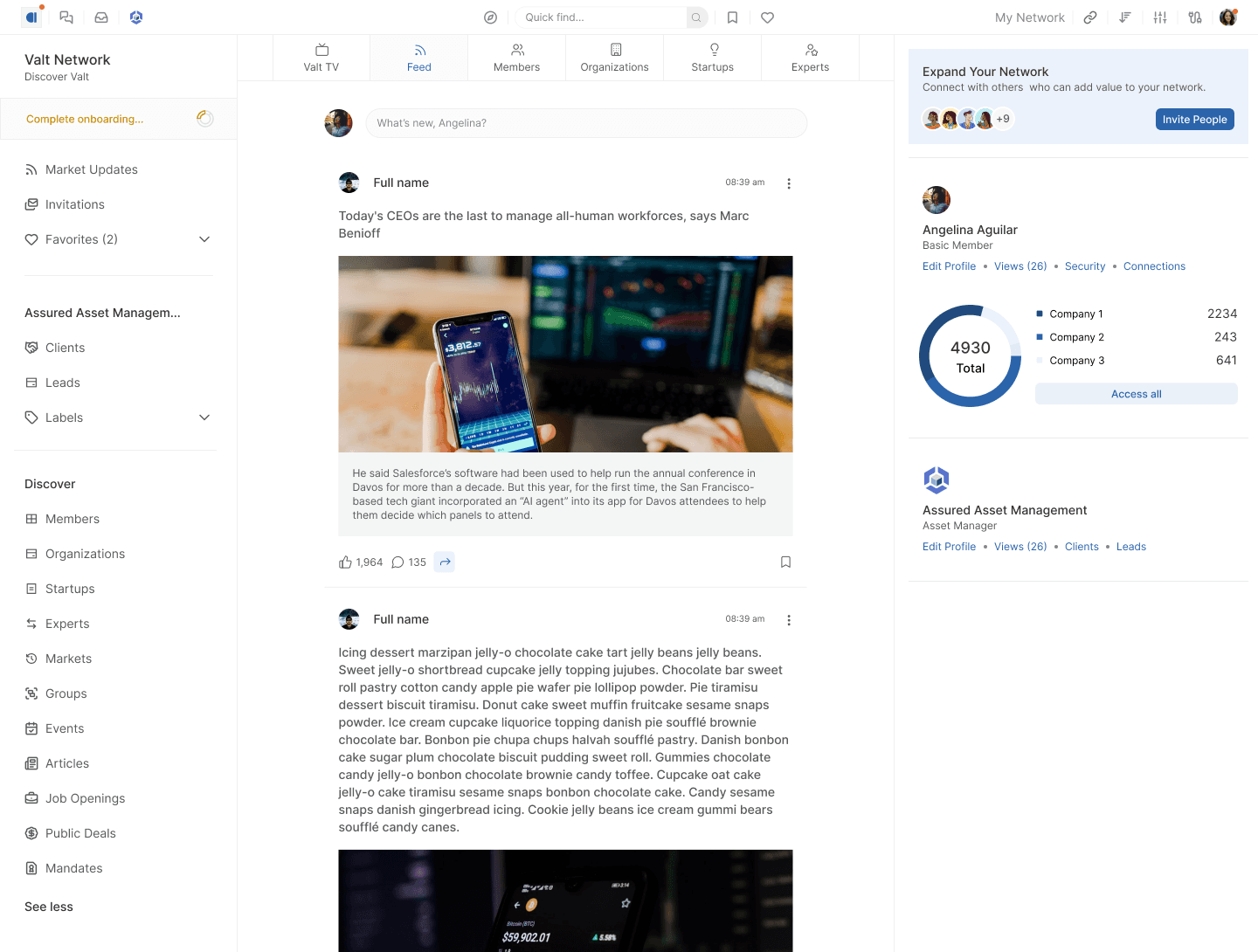
Social feed · Vault Network web app

Design Decisions

Key choices and why

The reasoning behind the most important decisions not just what was built, but the thinking that got there..

Decision 01

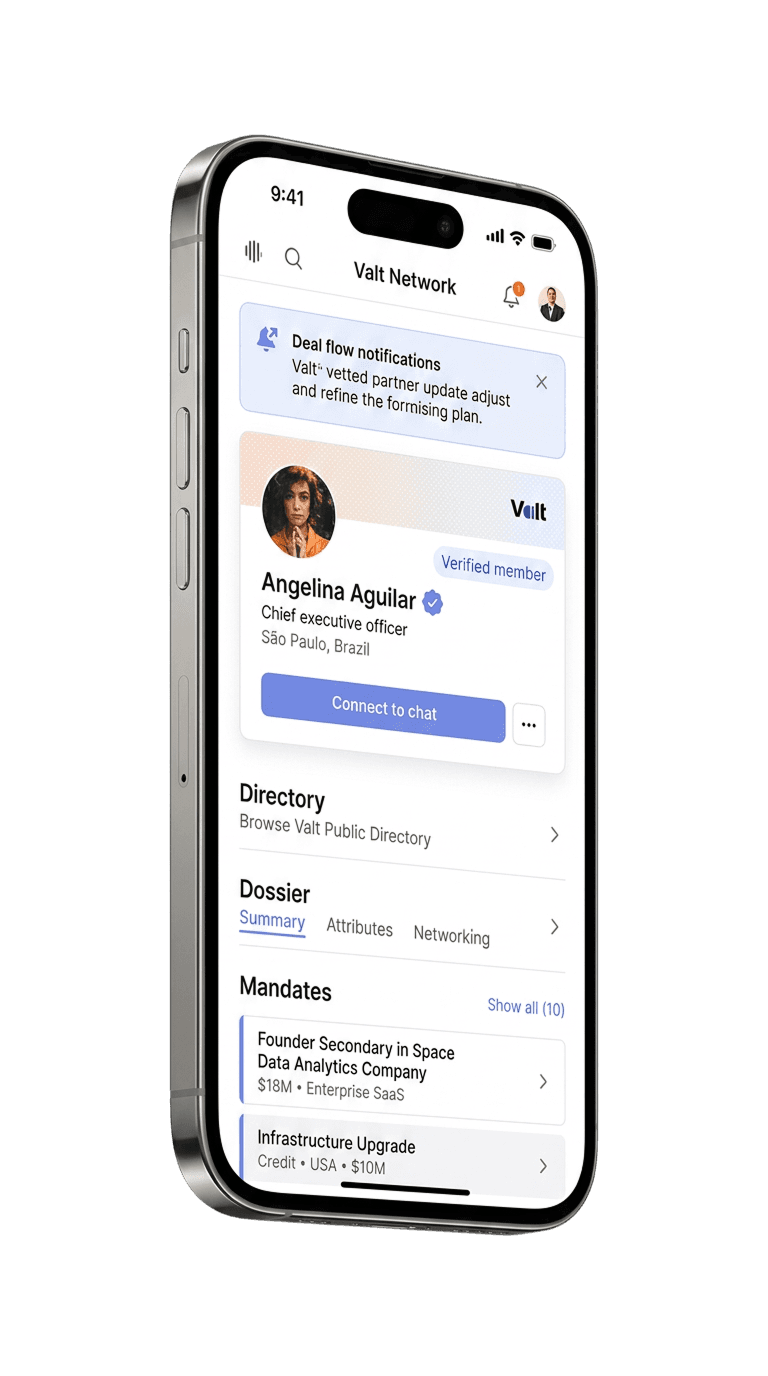
Verification as the Foundation

Private markets run on trust. Before designing any feature, I established verified identity as the core constraint: every profile, connection, and deal signal had to be anchored to a verified user. This shaped the entire onboarding flow and prevented the noise problem that plagues LinkedIn and AngelList.
Decision 02

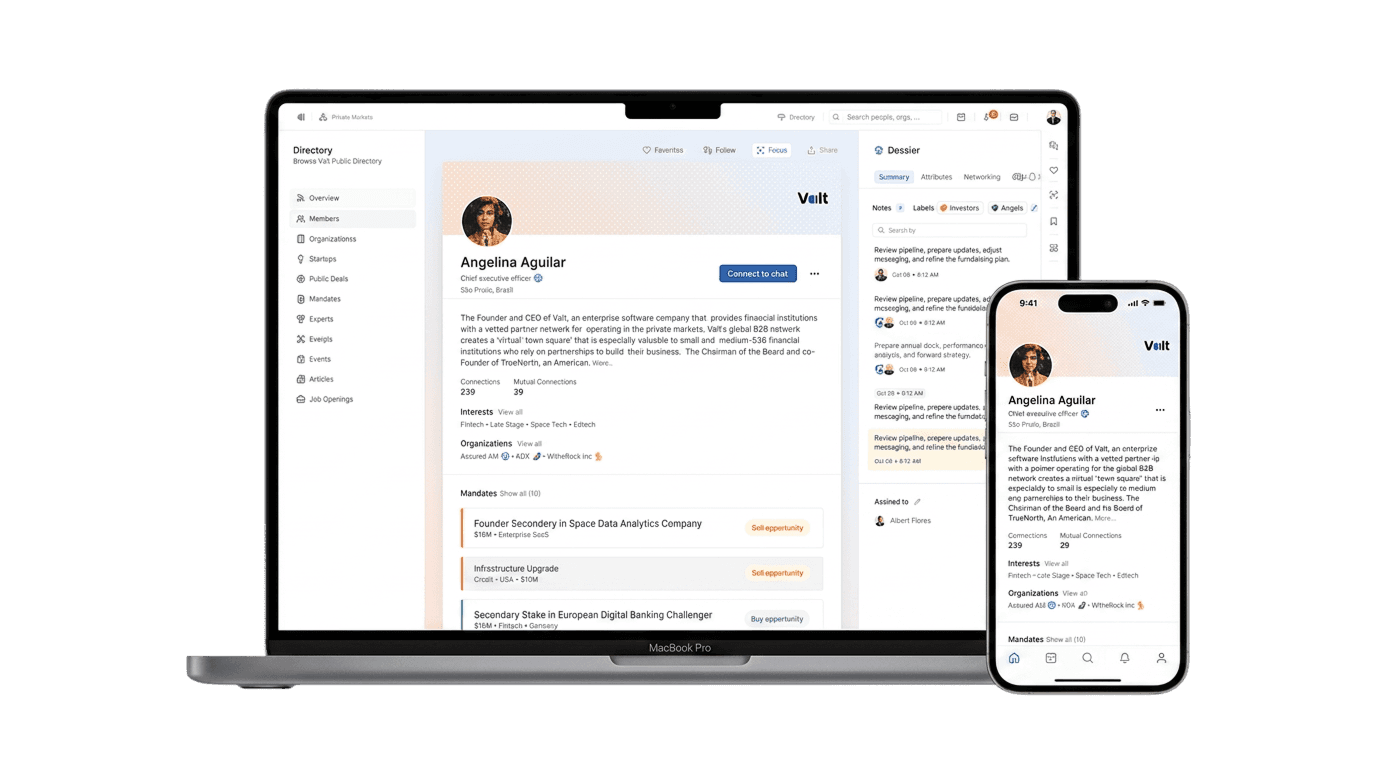
Two Distinct User Experiences

Investors and companies have fundamentally different goals. Rather than forcing both into one generic feed, I designed separate profile architectures: investors have a mandate-driven profile showing thesis and focus areas; companies have a dossier-style profile controlling what information is shared and with whom.

Learnings

What I took away

What worked well

Starting with the Whitespace

The competitive analysis of LinkedIn, AngelList, and Carta revealed a clear gap: no platform served verified, thesis-aligned private market connections. Starting the design process from that whitespace gave every decision a clear north star and prevented scope creep throughout the 12-month engagement..

WHAT I'D PUSH FURTHER

User Testing with Real Investors

The product was designed based on stakeholder interviews and competitive analysis. With more time, I would have run structured usability tests with LP and GP users earlier in the process to validate the deal flow logic before going into high-fidelity screens.

KEY INSIGHT

Trust is a Design System

In private markets, the product is trust. Every design decision, from profile verification to information access controls, was a trust decision. The UI was the surface. The architecture was the product.

ROOM TO GROW

Designing for Regulated Markets

This project introduced me to the intersection of finance, compliance, and product design. The constraints around information sharing in private markets pushed me to think beyond UX patterns into legal and regulatory territory. An area I want to go deeper in.

Outcome

The platform is live.

The platform is live.

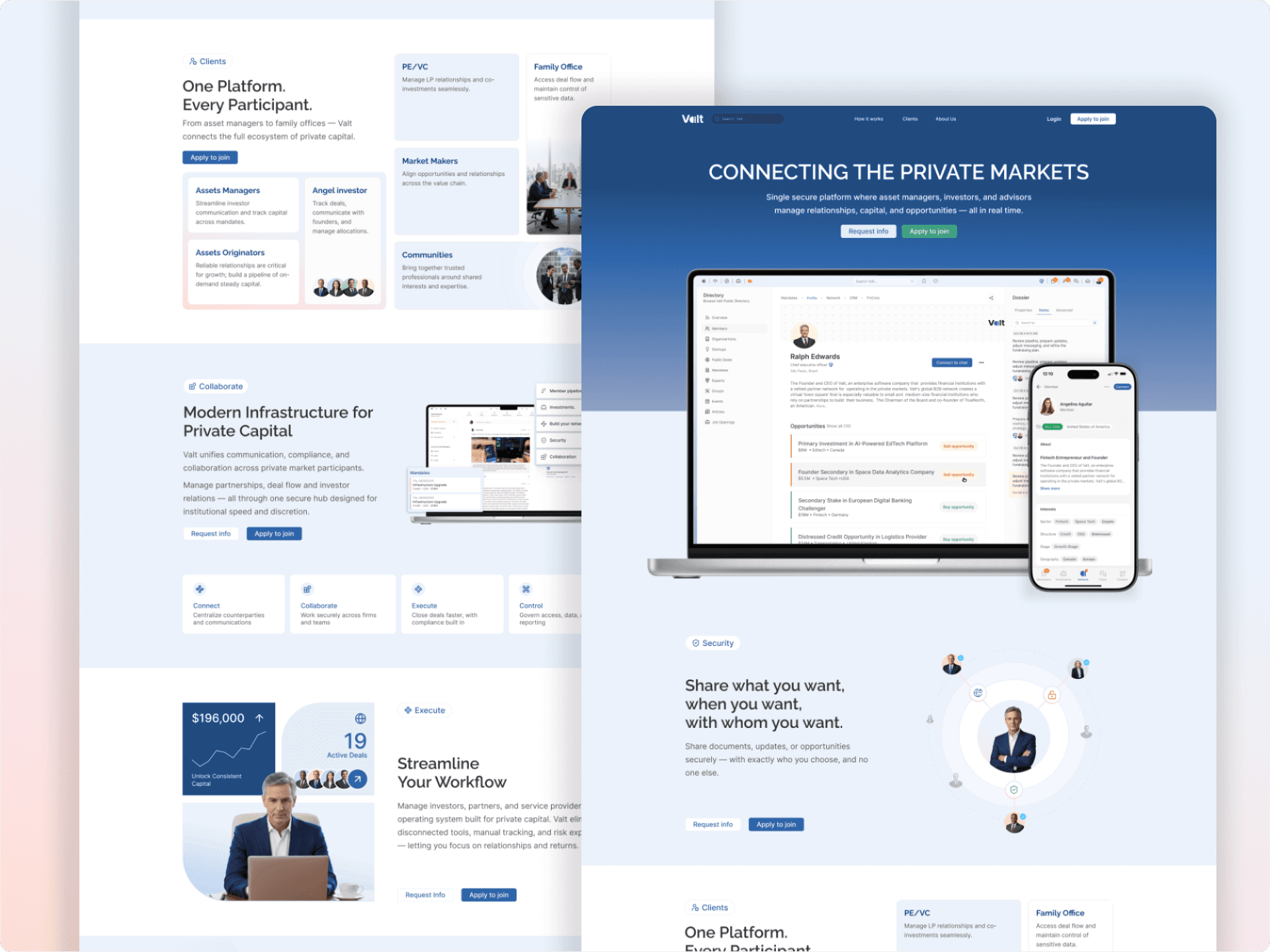
Vault Network launched at valtnetwork.com. A full-featured private market social product, built from zero over a 12-month engagement.

Outcome

The platform is live.

Vault Network launched at valtnetwork.com. A full-featured private market social product, built from zero over a 12-month engagement.

Learnings

What I took away

What worked well

Starting with the Whitespace

The competitive analysis of LinkedIn, AngelList, and Carta revealed a clear gap: no platform served verified, thesis-aligned private market connections. Starting the design process from that whitespace gave every decision a clear north star and prevented scope creep throughout the 12-month engagement..

WHAT I'D PUSH FURTHER

User Testing with Real Investors

The product was designed based on stakeholder interviews and competitive analysis. With more time, I would have run structured usability tests with LP and GP users earlier in the process to validate the deal flow logic before going into high-fidelity screens.

KEY INSIGHT

Trust is a Design System

In private markets, the product is trust. Every design decision, from profile verification to information access controls, was a trust decision. The UI was the surface. The architecture was the product.

ROOM TO GROW

Designing for Regulated Markets

This project introduced me to the intersection of finance, compliance, and product design. The constraints around information sharing in private markets pushed me to think beyond UX patterns into legal and regulatory territory. An area I want to go deeper in.